Affiliate Marketing Training for Beginners: Should You Pay for It?
Table of Contents
Affiliate marketing training for beginners can be helpful, but it is not automatically worth paying for. A lot of people enter this space feeling unsure, so the idea of a course, coach, or “done-for-you” roadmap sounds reassuring. That is understandable. The problem is that some training is genuinely useful, while some of it is just sales pressure dressed up as education.
If you are completely new, it makes more sense to understand the basics first. This guide on affiliate marketing for beginners is the right foundation before you pull out your bank card.
Quick Answer
Most people do not need expensive training to begin. In many cases, free or low-cost learning is enough to help a beginner understand how affiliate marketing works, what the real work looks like, and what warning signs to watch for. Paid training can make sense later, but only if it is specific, realistic, and genuinely practical.
Why this question matters
Beginners usually do not buy training because they are lazy. They buy it because they want clarity. The online income world is noisy, full of contradictions, and packed with people making big promises. A course seems like a shortcut through the chaos.
Sometimes it is.
Sometimes it is just a more expensive way of getting confused.
The cost matters because early money is usually limited. If a beginner burns cash on weak training, that creates pressure. Pressure then leads to bad decisions, unrealistic expectations, and the temptation to believe even bigger promises.
What free learning can already do
Before paying for anything, a beginner can learn a lot from trustworthy public information and from doing some careful reading. You can learn how affiliate links work, why trust matters, why disclosure matters, and why content usually matters more than flashy tactics.
If you are still at the stage of deciding whether this model suits you at all, the Start Here guide is a better first step than buying a course too early.
Free learning is often enough to answer the important early questions:
- What is affiliate marketing really?
- What kind of work does it involve?
- What should a beginner avoid?
- What sounds realistic and what sounds like rubbish?
That early clarity matters more than any premium dashboard or members’ area.
When affiliate marketing training for beginners may be worth it
Affiliate marketing training for beginners may be worth paying for when it removes confusion in a practical way. Good training should make the path clearer, not just make the dream feel bigger.
It may be worth considering if it does three things well.
First, it teaches one clear approach instead of throwing twenty strategies at you.
Second, it explains the work honestly, including the slow parts and the limits.
Third, it gives practical structure. That means real steps, real examples, and realistic expectations.
That is very different from training that mainly sells excitement.
What official guidance tells you
No official regulator is going to tell you which course is “best,” but official guidance does tell you something important: you should treat money-making offers with care.
The FTC’s Business Opportunity Rule requires covered sellers to provide certain information to help buyers evaluate business opportunities. FTC consumer guidance also warns that money-making opportunity scams often use persuasive language, hopeful promises, and vague systems to pull people in. The FTC has also proposed stronger action aimed at deceptive earnings claims in money-making opportunities, which tells you the wider problem is serious enough to attract regulatory focus.
That does not mean every paid course is bad. It means you should stop treating every polished sales page as proof.
Warning signs the training is weak
This is where beginners get caught.
If a sales page talks constantly about freedom, lifestyle, fast results, or screenshots, but stays vague about the actual lessons, that is a bad sign. If it leans on urgency, countdown timers, or emotional pressure, that is another bad sign. If the course creator acts as if all failure comes from “not wanting it enough,” that is usually nonsense.
Weak training often has one job: make uncertainty feel painful enough that buying feels like relief.
That is not teaching. That is manipulation.
A better way to judge it
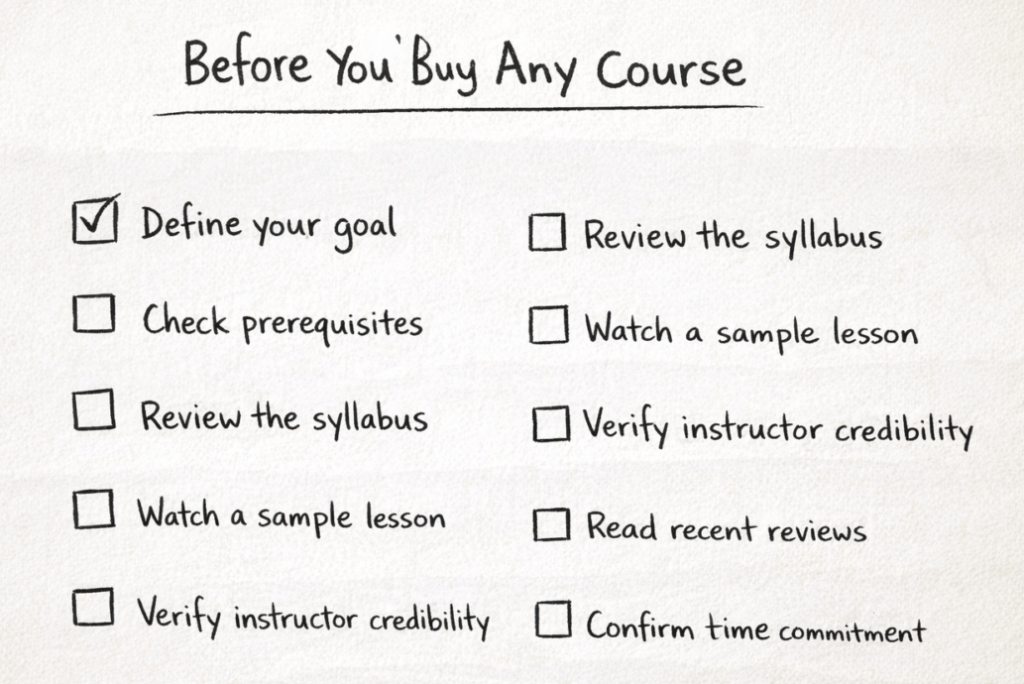
Ask four blunt questions before paying:
- What exactly will I be able to do after this?
- Can I see clear lesson topics, not just hype?
- Does it explain the work honestly?
- Would this still look useful if all the income claims vanished?
That last question matters most. Strip away the dream and see what is left.
If what remains is structured, practical, and clear, it may have value.
If what remains is fog, avoid it.
Why starting simple is often smarter
Most beginners are better off starting with one topic, one platform, and a basic understanding of how affiliate links and useful content work. That is slower than buying a miracle shortcut, but it builds judgment, and judgment is what stops you wasting time later.
That matters if your long-term goal is something realistic, like whether you can build a second income in your spare time, rather than chasing internet theatre.
Conclusion
So, affiliate marketing training for beginners can be useful, but it should never be treated as an automatic requirement. The best first move is not “buy something.” The best first move is to understand the model well enough to judge what is worth buying and what is not.
A good course can save time. A weak one can drain money and confidence. That is why calm judgment matters more than excitement.
FAQ
Is affiliate marketing training for beginners necessary?
No. Many beginners can learn the basics without paying for expensive training. Paid help only becomes worth considering when it offers real structure and realistic guidance.
What should affiliate marketing training for beginners include?
It should include a clear method, honest explanation of the work involved, realistic expectations, and practical steps a beginner can actually follow.
How do I tell if a course is selling hype?
It should include a clear method, honest explanation of the work involved, realistic expectations, and practical steps a beginner can actually follow. Look at what it teaches, not just what it promises. If the sales page focuses more on lifestyle, earnings, or urgency than on clear lessons and real work, that is a bad sign.
About the Author

Richard Chambers writes Simple Income Guide to help beginners understand online income in a clear, realistic, and pressure-free way. The focus is on simple explanations, honest expectations, and practical guidance for people who want to make sense of online business models without hype.
Read more on the About page.