How Long Does It Take to Earn Your First Affiliate Commission?
Table of Contents
A first affiliate commission can take days, weeks, or much longer, and that uncertainty is exactly why beginners find this question frustrating. People want a timeline they can rely on. They want to know when the work starts to feel real.
The honest answer is that there is no universal timeline. The speed depends on your niche, your traffic, the relevance of the offer, the quality of the content, and how realistic your expectations are from the start.
If you are still at the beginning, read Affiliate Marketing for Beginners first. It will help you understand the wider process before you start measuring everything by the clock.
Quick Answer
A first affiliate commission can happen quickly, but for many beginners it takes longer than expected. There is no guaranteed timeframe. What matters more is whether your content is useful, your recommendations fit the audience, and your site is being built on realistic expectations rather than hype.
Why the timeline varies so much
Different websites start in very different places. Some already have traffic from an audience, a social following, or a mailing list. Others start from zero. Some promote offers with quick decisions. Others deal with slower decisions, more cautious buyers, or offers that need more explanation.
That is why comparisons can be misleading.
A beginner who hears that someone else got a commission in three days may assume that should be normal. It may not be normal at all. It may just reflect a completely different setup.
What affects a first affiliate commission most
A first affiliate commission is usually shaped by a few basics.
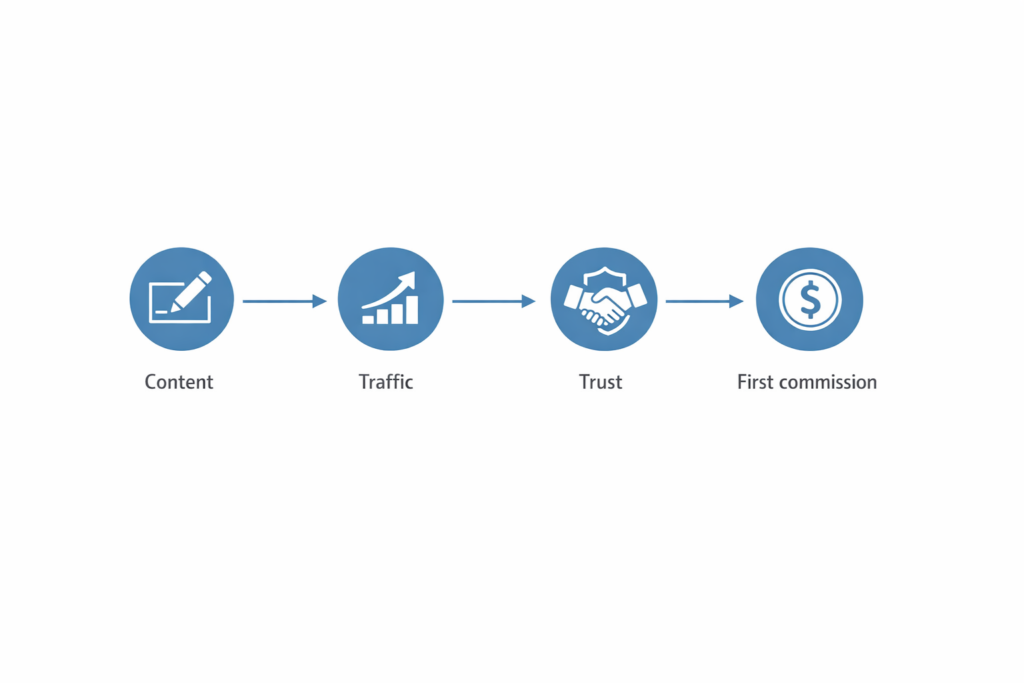
One is traffic. If very few people see the content, commission is likely to take longer.
Another is fit. If the offer does not match the audience well, even decent traffic may not convert.
Another is clarity. If the content is vague, rushed, or unhelpful, readers may not trust the recommendation enough to act.
And another is patience. Many beginners stop or change direction too early because they expected proof almost immediately.
Why unrealistic timelines do damage
This is where bad advice hurts people.
The Federal Trade Commission continues to warn about money-making opportunity scams, and one reason these offers work is that they prey on urgency and hope. When beginners are told to expect instant earnings, they interpret any slower result as failure.
That is dangerous. It pushes people to abandon sensible work, jump between models, or chase even more exaggerated promises.
A better mindset is slower and less dramatic. Build useful content, make sure the recommendations fit, and give the site time to gather momentum.
What a healthy early target looks like
A healthy early target is not “earn immediately.” It is “create something useful enough that the first commission would make sense if it came.”
That shift matters.
If your early goal is usefulness, the site improves even before the first sale happens. If your only goal is immediate commission, you are more likely to force products, overthink numbers, and lose patience.
This is one reason the Start Here page is helpful. It frames online income as something to understand properly, not as a speed contest.
What beginners should do while waiting
While waiting for the first commission, there are still better and worse ways to spend your time.
Better uses of time include improving existing articles, clarifying recommendations, strengthening internal links, and publishing more genuinely useful content.
Worse uses of time include refreshing dashboards constantly, changing niche every week, and rewriting your whole plan because nothing happened in the first few days.
Google’s guidance on helpful, reliable content also supports the idea that long-term usefulness matters more than rushing to monetise every page.
A realistic way to think about progress
Progress in the early stage usually shows up before commission does. A page gets clearer. Another article answers an objection better. Internal links become stronger. Your writing becomes more natural. Readers spend longer on the site. Those are all useful signs.
If your larger aim is something stable rather than dramatic, this fits closely with the thinking in Can You Really Build a Second Income in Your Spare Time?. Slow progress is still progress.
Conclusion
So, how long does a first affiliate commission take?
Longer than some people claim, shorter than others fear, and never on a guaranteed schedule. The real issue is not chasing a perfect timeline. It is building a site and a set of recommendations that make a first commission believable when it eventually comes.
If you stay useful, realistic, and patient, the early stage becomes much easier to handle.
FAQ
How long does a first affiliate commission usually take?
There is no fixed timeline. For some beginners it can happen quickly, but for many it takes longer because traffic, fit, and trust need time to develop.
Why have I not earned a first affiliate commission yet?
Possible reasons include low traffic, weak fit between the content and the offer, unclear recommendations, or unrealistic timing expectations.
Should I change my whole strategy if nothing happens quickly?
Not automatically. It is often better to improve the usefulness of the content and give the site more time before making big changes.
About the Author

Richard Chambers writes this guide to help with online business for beginners and other simple income models. Simple Income Guide helps beginners understand online business in a clear, realistic, and pressure-free way. The focus is on simple explanations, honest expectations, and practical guidance for people who want to make sense of online business models without hype.
Read more on the About page.